
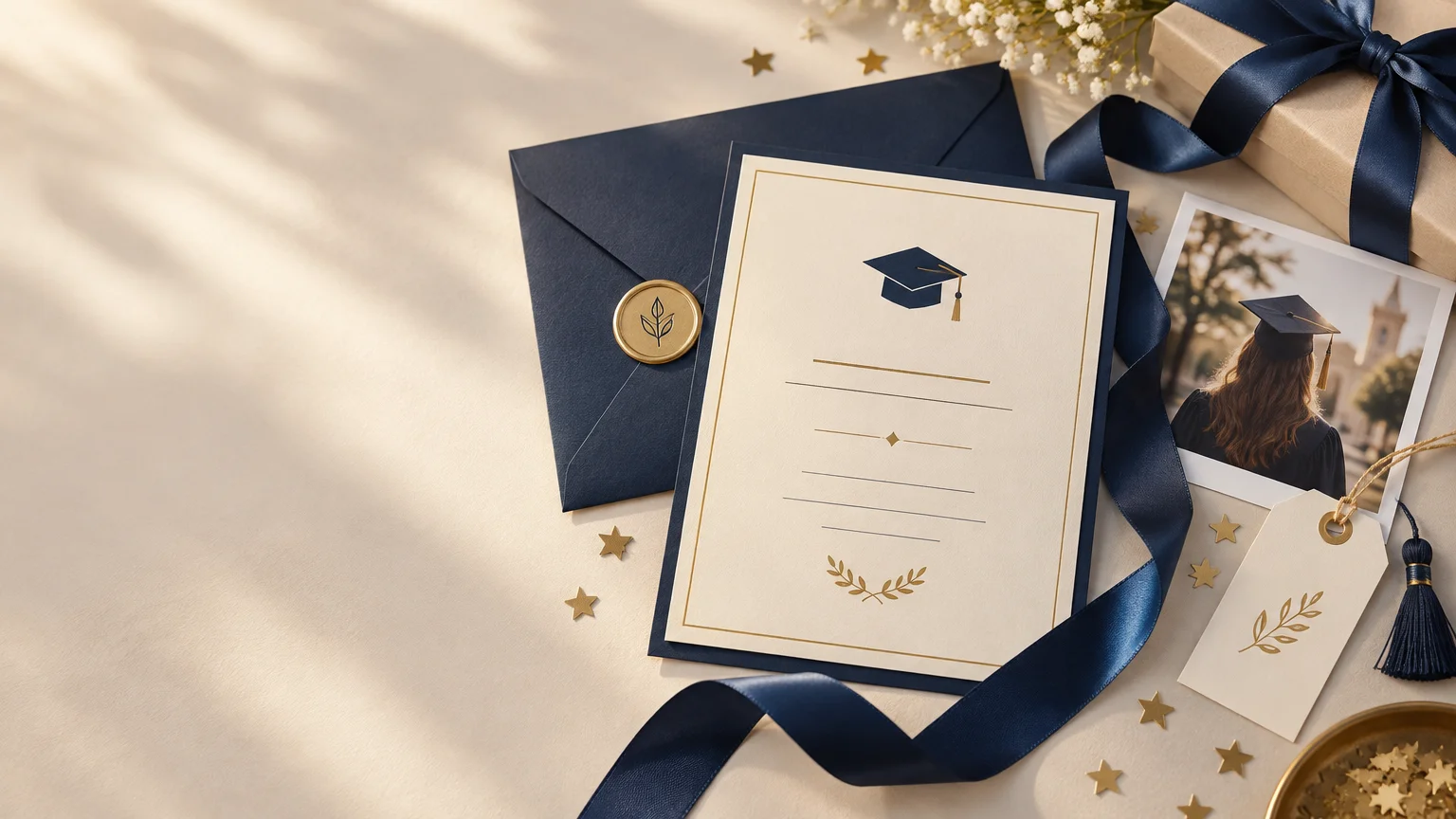
The best graduation invitations do two things at once: celebrate the graduate’s personality and tell guests exactly where to be, when to arrive, and how to respond. Start by deciding what you are inviting people to—the commencement ceremony, an open house, a seated dinner, or a casual party—because that choice controls the guest list, wording, design, and mailing schedule.
A good invitation does not need a long biography or every school accomplishment. It needs one clear purpose, complete event details, and one or two personal elements that make it feel chosen for this graduate. A meaningful photo, school colors, a favorite quote, or a small reference to the graduate’s next chapter will usually do more than a crowded collection of decorative motifs.
First, decide whether you need an invitation or an announcement
Graduation invitations and graduation announcements are related, but they are not interchangeable. An invitation asks someone to attend a ceremony, open house, or party. An announcement shares the news of the graduation without asking the recipient to appear at an event. The National League of Junior Cotillions graduation etiquette guidance makes this distinction explicitly.
| Card type | What it communicates | Who should receive it |
|---|---|---|
| Ceremony invitation | Please attend the commencement ceremony | Guests covered by the graduate’s available ceremony tickets or seats |
| Party or open-house invitation | Please join the graduation celebration | People the host can comfortably accommodate at the venue |
| Graduation announcement | The graduate has reached this milestone | Friends, relatives, mentors, and supporters, including those who cannot attend |
| Combined announcement and party invitation | The graduate has finished school, and you are invited to celebrate | Guests invited to the party, with the party request stated unmistakably |
This distinction matters most when commencement seating is limited. Build the ceremony list around the number of tickets or seats allowed by the school, then use announcements for extended family, former teachers, neighbors, and other supporters who would appreciate the news but cannot be accommodated at the ceremony.
An announcement also should not read like a bill disguised as good news. Receiving one does not obligate the recipient to send a gift. A card, call, note, or congratulatory message is an entirely appropriate response, while a gift remains the recipient’s choice.
Choose an invitation idea that fits the graduate
The strongest design usually grows from one recognizable detail rather than a generic pile of diplomas, caps, confetti, and gold stars. Think about what friends and family associate with the graduate, then choose a visual direction that can support readable event information.
Photo-forward and personal
Use one strong portrait on the front and keep the event details on the reverse or beneath the image. A senior photo is the obvious choice, but it is not the only one. A candid picture from the workshop, theater, laboratory, playing field, or family kitchen may say more about the graduate’s experience.
If the card includes several photos, give them a reason to be together. A small sequence—first day, favorite school memory, graduation portrait—feels intentional. A dozen unrelated images can quickly compete with the date and address.
School colors with a grown-up finish
School colors are easy to personalize without turning the invitation into a pep-rally poster. Use the darker color for type, the brighter color as a border or small accent, and leave enough open space around the wording. A matte or lightly textured paper can make a simple two-color design feel substantial.
A design inspired by the next chapter
The invitation can look forward as well as back. A subtle city map suits a graduate moving away. Botanical line art works beautifully for a garden party. Technical drawings, musical notation, books, travel marks, or hand-drawn tools can nod to the graduate’s interests without becoming costume-like.
A keepsake-style invitation
For close relatives and mentors, consider a design that will still feel meaningful after the party. A clean portrait, full name, school, graduation year, and short handwritten message can turn the invitation into a small keepsake. Premium paper and restrained foil or pearlescent accents can heighten that effect, but the finish should support the design rather than overwhelm it. For help comparing tactile treatments, see premium print finishes that make gifts feel more special.
What every graduation invitation should include
Before writing the celebratory line, collect the practical facts. Graduation invitations should include the date, time, location, relevant dress expectations, and RSVP information. For a ceremony, also clarify whether the invitation covers the commencement itself, a separate celebration, or both.
- Graduate’s full name
- School, college, university, or program name
- Credential or graduating class, when relevant
- Exact event being held: commencement, party, dinner, brunch, or open house
- Day and date
- Start time and, for an open house, the time range
- Venue name and complete street address
- RSVP method and deadline
- Dress guidance if guests would not otherwise know what to wear
- Parking, accessibility, entrance, or ticket instructions when needed
- A separate website or details card for information that would crowd the invitation
Read the finished wording as though you know nothing about the plan. “Join us after graduation” may sound cheerful, but it leaves several questions unanswered. After which ceremony? At what time? At the family home or another venue? Is a reply expected? Warmth is welcome; ambiguity is not.
Graduation invitation wording examples
Use these as frameworks rather than scripts. Replace every bracketed item, remove any line that does not apply, and match the formality to the event.
Formal commencement invitation
Please join us in celebrating the graduation of [Graduate’s Full Name] from [School or University]. Commencement will be held on [Day, Date] at [Time] at [Venue, Address]. Admission requires the enclosed guest ticket. Please arrive by [Time].
Casual graduation party
The studying is done—now it is time to celebrate! Join us for [Graduate’s Name]’s graduation party on [Day, Date] from [Start Time] to [End Time] at [Location and Address]. Please reply by [Date] to [Name and Contact Method].
Open-house invitation
Drop in and help us celebrate [Graduate’s Name], a graduate of [School or Program]. Our open house will be held on [Day, Date] from [Start Time] to [End Time] at [Address]. Come when you can and stay for refreshments, photographs, and plenty of congratulations. RSVP to [Contact] by [Date].
College graduation with degree information
With pride and happiness, we invite you to celebrate [Graduate’s Full Name] upon earning a [Degree or Credential] in [Field] from [Institution]. Please join us for [Dinner/Reception/Open House] on [Day, Date] at [Time], [Venue and Address]. Kindly respond by [Date].
Combined announcement and party invitation
We are delighted to announce that [Graduate’s Full Name] has graduated from [School or Program]. Please join us for a celebration in [their] honor on [Day, Date] from [Time] at [Venue and Address]. RSVP by [Date] to [Contact Method].
If gifts are not expected, you may add a brief line such as “Your good wishes are all the gift we need.” Do not let that note become the loudest message on the card. The graduate and the occasion should remain at the center.
Give guests enough notice
Work backward from the event rather than choosing a mailing date by instinct. Etiquette guidance from the National League of Junior Cotillions identifies about four weeks before the event as a target for mailed ceremony invitations and 14 days as an acceptable minimum, with additional notice helpful when guests must travel.
Your printing deadline must come earlier than your mailing deadline. Production and carrier transit are separate stages. PrintInvitations says most of its orders are produced within three business days or less and many ship within one business day, but customization, proof approval, order size, and seasonal demand can affect timing. Never treat a normal production estimate as a guaranteed arrival date.
- Confirm the ceremony tickets, party venue, date, time, and guest capacity.
- Collect addresses and decide who receives an invitation versus an announcement.
- Choose the design, paper, envelopes, wording, and quantity.
- Submit the order with enough time for proof review and corrections.
- Approve the proof only after another person checks every event detail.
- Allow separate time for production, shipping, addressing, postage, and mailing.
- Send early enough for travelers to make plans and for the host to collect replies.
If you want a coordinated printed suite rather than assembling unrelated pieces, Print Invitations custom cards and event stationery can support invitations, announcements, details cards, and other paper elements in one visual direction.
Proof the details guests cannot afford to misunderstand
A beautiful typo is still a typo. Check the graduate’s name, school, date, day of the week, time, venue, street address, RSVP contact, deadline, punctuation, capitalization, and overall readability. Those are among the proof-review checks identified by the printer in its personalization guidance.
Confirm the day and date together against a calendar. Call or check the venue’s official information rather than copying an address from an old message. Test any QR code from a printed proof or full-size printout, and make sure the linked page works for someone who is not signed into your account.
Read the card at its intended size. Delicate script may look graceful while enlarged on a screen and become frustratingly small in print. Reserve decorative lettering for the graduate’s name or a short heading; use a clear typeface for the address, response deadline, and arrival instructions.
When paper feel or print finish is important, a physical sample can reveal more than an onscreen image. PrintInvitations states that a physical proof or sample is available for a nominal fee and can help a customer assess paper weight, finish, print clarity, and in-hand presence.
Plan the envelope before adding ribbons and seals
Presentation begins before the envelope is opened, but elaborate details can change how a piece travels through the mail. According to the USPS guidance for letters and postcards, a letter-rate envelope must be paper, rectangular, flat, flexible, no more than 11½ inches long, 6⅛ inches high, and ¼ inch thick. Extra weight, oversize dimensions, and nonmachinable formats can require additional postage. Square and vertically oriented envelopes may also cost more.
That does not mean every invitation must be plain. It means embellishment should be planned rather than improvised on mailing day. USPS identifies rigid, lumpy, clasped, string-tied, and buttoned envelopes as nonmachinable. It advises placing invitations with exposed wax seals, ribbon, or string inside an outer envelope to help the decorated piece arrive intact. An embellished invitation can also be taken to a retail counter for hand-canceling, subject to the applicable postage.
Make the presentation personal without making it fussy
The envelope gives you several quiet opportunities to personalize the invitation. Choose one or two; you do not need all of them.
- Write a short note to a grandparent, mentor, or former teacher on a separate card.
- Use an envelope liner featuring school colors, a campus sketch, or a subtle pattern.
- Add a small details card for parking, accessibility, reception directions, or ticket instructions.
- Coordinate the return address with the invitation typography.
- Include a recent photograph that the recipient may want to keep.
- Use a belly band or ribbon only when it can be protected inside the mailing envelope.
- Address close recipients by hand if time allows, while keeping every delivery address clear and legible.
USPS places the return address in the upper left of the envelope and the delivery address in the lower center. It recommends clear printing and ZIP+4 when possible. Ornate calligraphy is lovely only if the postal information remains easy to read.
The celebration can continue after the event with a personal thank-you. A short card gives the graduate room to mention the recipient’s attendance, encouragement, or gift. If you are deciding how much space the message needs, this comparison of personalized thank-you cards and gift tags can help.
A final pre-mailing checklist
- The card clearly says whether it is an invitation, announcement, or both.
- The ceremony guest count does not exceed the available tickets or seats.
- The day, date, time, venue, and address have been independently checked.
- The RSVP method works and the deadline leaves time for final planning.
- Travelers will receive enough notice.
- The smallest practical text is readable at actual size.
- Any QR code opens the correct page without requiring private account access.
- The complete stuffed envelope has been checked for size, thickness, flexibility, and postage.
- Decorative seals, ribbon, or bulky elements are protected by an outer envelope when necessary.
- A few extra copies are reserved for late additions and the graduate’s keepsake box.
Let clarity carry the celebration
A graduation invitation does not need to summarize years of hard work. It needs to open the door to one meaningful gathering. Choose the correct card type, make the event unmistakable, proof every practical detail, and add one personal element that belongs to the graduate alone.
That might be a portrait the family loves, a line borrowed from the graduate’s own speech, a school-color envelope liner, or a handwritten note to the teacher who helped along the way. Small, specific choices are what turn graduation stationery from an event notice into a keepsake—and make every guest feel genuinely invited to celebrate.