
TLDR
A handwritten note keepsake gift works best when the message is specific, the format suits the recipient, and the presentation gives the words a sense of occasion. Write about one meaningful memory, explain what the person means to you, and close with a thought about the future. Then present the note as the main gift, pair it with a modest object, or gather several messages into a coordinated collection. If the original letter is valuable or irreplaceable, store it safely and display a copy instead.
The important word here is not “handwritten.” It is “specific.” Beautiful paper cannot rescue a generic message, while an honest paragraph on an ordinary card can become the part someone saves for years. Start with what you want the recipient to remember, and choose the box, ribbon, frame, or envelope afterward.
Decide what role the note will play
Before choosing stationery, decide how the recipient should encounter the message. A note can be the gift itself, an introduction to another gift, a private surprise hidden inside the packaging, or one contribution to a collection from several people.
| Format | Best for | Presentation approach |
|---|---|---|
| One complete letter | Anniversaries, graduations, farewells and major thank-yous | Place it in an envelope or document sleeve and let it be the center of the reveal. |
| Several short notes | Birthdays, long-distance relationships and ongoing encouragement | Label the envelopes by date, mood or occasion, such as “Open when you need a laugh.” |
| Photo and letter pairing | Family milestones, memorial gifts and friendship keepsakes | Place the photo and note together without attaching adhesive directly to an important original. |
| Family story or recipe note | Reunions, new homes and intergenerational gifts | Write the story behind the recipe, person or tradition rather than providing only instructions. |
| Group message collection | Retirements, weddings, teacher gifts and workplace farewells | Use matching cards or sheets, then arrange them in a box, binder or tied bundle. |
| Hidden note | Any gift that needs one final personal detail | Tuck it under the box lid, inside a book or beneath the main item where it will be discovered naturally. |
If the recipient enjoys sentimental objects, let the letter take center stage. If they prefer practical gifts, pair it with something useful and allow the note to explain why you chose it. A travel mug becomes more personal when the message recalls early morning conversations; a cookbook feels considered when the note names the meal you hope to make together.
For a workplace gift, keep the message warm but appropriate and connect it to a real contribution. The same principle applies when choosing personalized employee appreciation gifts: a specific reason for the thanks matters more than an elaborate package.
What to write in a handwritten note keepsake gift
You do not need to produce a sweeping life story. Most keepsake notes need only four elements: the occasion, one concrete detail, what that detail reveals about the recipient, and a forward-looking closing.
- Name the moment. Say why you are writing now rather than opening with a vague greeting.
- Recall one specific detail. Mention a conversation, habit, shared place, small kindness or funny incident.
- Explain its meaning. Tell the recipient what that memory showed you or why it has stayed with you.
- Connect the note to the gift, if there is one. Explain the choice without describing its price or turning the message into a product summary.
- Look forward. End with a hope, promise, invitation or reminder that carries the relationship beyond the occasion.
A short worked example
A generic birthday line might say, “I hope you have a wonderful day. You deserve the best.” A keepsake version could say, “I still think about the rainy birthday when you carried the cake across town under your coat so it would stay dry. You have always made people feel celebrated, even when doing so is wildly inconvenient. This little serving plate reminded me of every gathering you have made warmer. I hope we fill it with many more birthday cakes together.”
The second version works because another person could not receive it unchanged. That is a useful test: if you can replace the recipient’s name without rewriting the message, add a detail only they would recognize.
How long should the note be?
Write only as much as the relationship and occasion can support. A gift-box note may need one substantial paragraph. A retirement or anniversary letter can comfortably hold several memories. A collection from a large group works better when each contributor writes a short, focused message rather than competing to fill an entire page.
When emotions are complicated, clarity is kinder than length. One honest memory and one direct expression of gratitude can feel more genuine than a page of grand declarations.
Choose a presentation that supports the message
A keepsake presentation should slow the opening experience without creating a puzzle. Give the recipient a clear first step, protect the note from bending or spills, and keep decorative elements secondary to the handwriting.
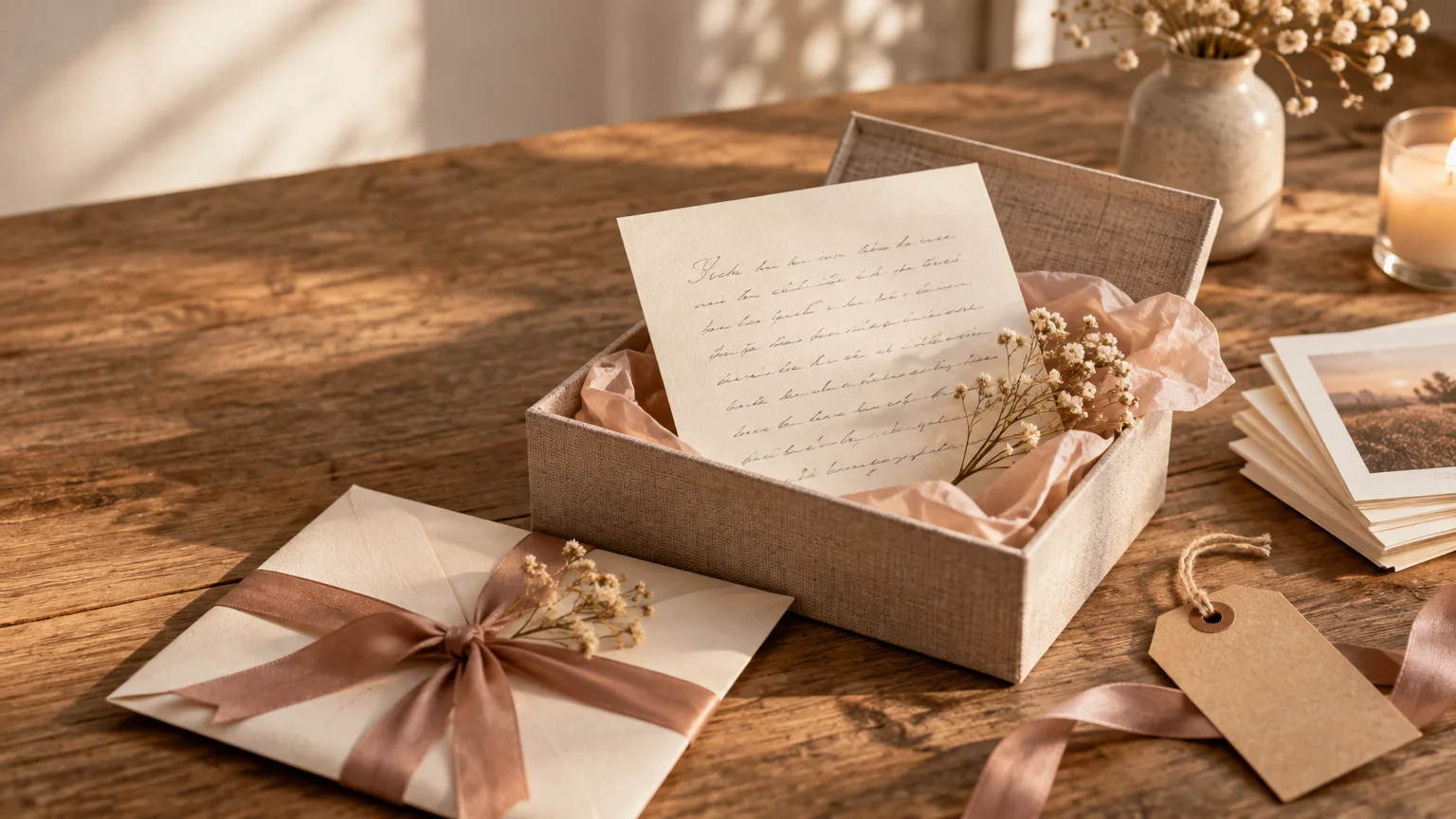
- Ribbon-tied envelope: Place the letter in a plain envelope, wrap it once with ribbon, and add a small name tag.
- Read-me-first layer: Set the envelope on top of the gift beneath the lid so the message provides context before the object is revealed.
- Belly-banded note stack: Align several short notes and wrap a paper band around the center. Add a title and date to the band.
- Nested envelopes: Use numbered envelopes when the messages form a sequence, such as past, present and future.
- Photo-and-letter sleeve: Put a copy of the letter beside a photograph in an archival-quality sleeve or suitable album page.
- Memory box: Combine the note with a few flat, meaningful items such as ticket stubs, copied photographs or a printed map of a shared place.
For an ordinary envelope or gift box, a coordinated seal can make the presentation feel finished. A date, monogram, tiny illustration or reproduced signature can work well on custom printed cards and event stationery when the note belongs to a wedding, shower or other gathering. For a broader coordinated package, this guide to a matching gift, card, and sticker set explains how to repeat one motif without making every component identical.
Ribbon is most effective when it creates structure rather than clutter. If you are tying the note to a box, choose the ribbon in proportion to the package and leave enough room for the name or message to remain visible. The practical guide to choosing ribbon width for a gift box can help when the note is part of a larger wrapped presentation.
Organize a collection of notes so it feels intentional
Group notes often become uneven: one person writes three pages, another contributes two lines, and someone submits a message on a different paper size. Instead of forcing every voice into the same length, standardize the outer structure.
- Give contributors the same prompt, such as “Share one moment that captures what we appreciate about Sam.”
- Set a practical maximum length so the collection remains readable.
- Ask each person to sign and date the message.
- Mount copies on matching backing sheets if the originals vary greatly in size.
- Arrange the notes chronologically, alphabetically or by theme, and explain that order on an opening card.
- Include one blank card for a future message from the recipient or group.
For a retirement gift, the sections might be “What you taught us,” “Moments we will remember,” and “What we hope you do next.” For a wedding, friends and relatives might share memories of each partner before ending with wishes for their shared future. A family birthday collection could be arranged by generation.
Protect a note that is meant to last
A sentimental note does not need museum treatment, but a few careful choices can help it survive. The Library of Congress recommends handling paper with clean hands, avoiding self-adhesive tape and glue, limiting exposure to light, and keeping paper in a cool, relatively dry and stable environment. It also identifies acid- and lignin-free folders, mats and document boxes as supportive storage enclosures. Read the Library of Congress guidance on caring for paper for more detailed preservation advice.
Do not permanently tape, laminate or glue an irreplaceable original simply to make it easier to display. A safer approach is to make a high-quality copy for the frame and place the original flat in an appropriate folder or document box. This is especially sensible for an old family letter, a note written by a child, or handwriting from someone who has died.
If you frame the original, use materials intended for preserving paper and place the display away from strong sunlight. Keep the note from touching damaging adhesives or unstable backing materials. When you are unsure whether an older document is fragile or valuable, favor reversible storage over a permanent craft treatment.
Mail the gift without turning the envelope into a package
A letter paired with photographs or other flat paper pieces may be suitable for an envelope, but hard, bulky or lumpy objects need more care. USPS explains that letters must meet applicable size and thickness requirements, and that square, rigid or unusually shaped pieces can be subject to different pricing or extra postage. It also warns against placing loose hard objects in a paper envelope. Check the current USPS guidance for sending letters before mailing.
When in doubt, mail the keepsake object in a protective package and place the letter inside that package rather than forcing both into a standard envelope. Keep the note in its own inner envelope or sleeve so it does not rub against a frame, ornament or other hard item in transit.
A final keepsake-note checklist
- Does the message include at least one detail unique to this person?
- Is the tone appropriate for the relationship and occasion?
- Will the recipient know what to open or read first?
- Is the handwriting legible, with enough space between lines?
- Have you signed and dated the note?
- Does the packaging protect the paper without overwhelming it?
- If the original is irreplaceable, should you display a copy and store the original?
- If mailing it, have you checked current postal requirements for its shape, rigidity and contents?
Make the words the part worth keeping
A handwritten note does not become a keepsake because it is long, ornate or written on expensive stationery. It becomes one when it records something true that the recipient would not want to lose.
Begin with one memory today. Write what happened, what it revealed about the person, and what you hope the two of you will share next. Sign it, date it, and give it a presentation that lets the words lead. The object may mark the occasion, but the personal message is often the part that stays.