
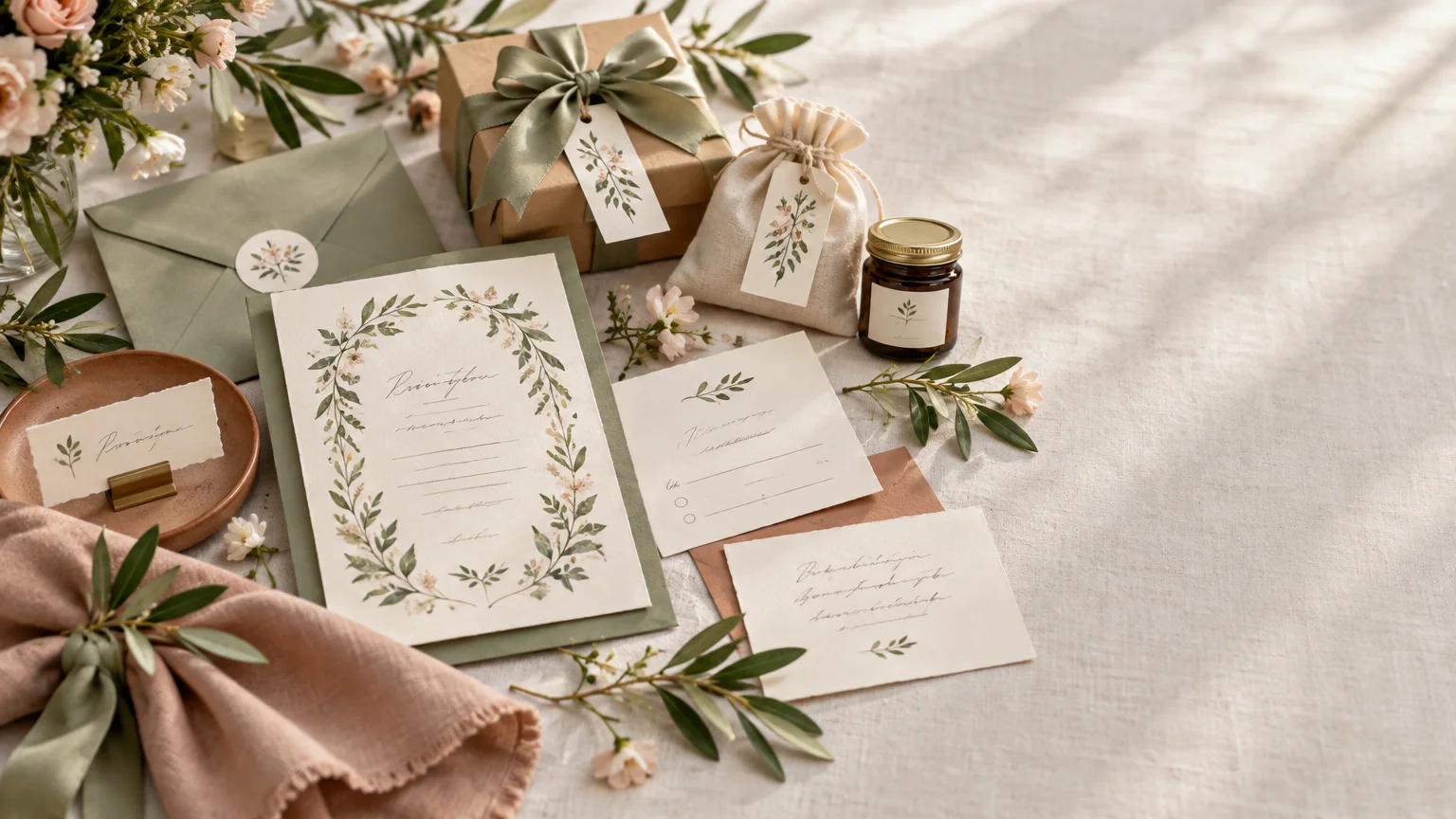
TLDR: PrintInvitations personalized event stationery works best when you begin with a clear wedding invitation and add matching pieces only when they have a practical job. Use save-the-dates for early notice, details cards for logistics, RSVP cards when you want mailed responses, and thank-you cards for the final note of gratitude. Carry one restrained visual element—such as a floral motif, monogram, color, or type style—onto welcome gifts and favors so the celebration feels coordinated rather than overdecorated.
A wedding invitation can do more than announce a date. It can establish the mood guests will encounter later in a welcome box, at their place setting, and in the thank-you note that arrives after the celebration. The secret is not putting the same design on everything. It is choosing a recognizable visual thread and giving every printed piece a clear purpose.
PrintInvitations is a practical option for the core suite because its wedding-focused selection includes invitations, save-the-dates, RSVP cards, details cards, and thank-you cards. Customers can start with a template or supply finished artwork, personalize the event information, and receive a free digital proof. The company also states that physical proofs and samples are available for a fee. That makes personalized wedding invitations and coordinated stationery a sensible starting point when you want the main paper pieces to share a consistent direction.
How to Make Personalized Event Stationery Feel Intentional
Personalization is more persuasive when it reflects the couple and helps the guest. Names and a wedding date are only the beginning. A garden illustration connected to the venue, a tiny drawing of the couple’s dog, or a color borrowed from a meaningful place can turn an otherwise standard suite into something recognizable.
Choose one primary element and one supporting element. For example, pair a loose botanical illustration with dark green type, or use a simple monogram with a warm cream-and-terracotta palette. Repeating five decorative ideas across every item usually creates visual noise. Repeating one motif with small variations creates continuity.
Readability still comes first. The couple’s names can be expressive, but the date, time, venue, response deadline, and website should be easy to scan. Fine script, pale colors, and crowded layouts may look romantic on a screen while becoming difficult to read in print. Review the proof at approximately its intended physical size instead of judging only from a zoomed-in view.
Build the Core Suite Before Adding Gift Details
Start with the invitation because it sets the hierarchy for everything else. Once its wording, colors, typography, and central motif are settled, decide which supporting pieces solve genuine communication needs. This core-first method prevents a pretty suite from becoming a thick packet of repetitive information.
| Stationery piece | Practical job | When to add it | Gift-like contribution |
|---|---|---|---|
| Save-the-date | Gives guests early notice | Useful when guests need to arrange travel, lodging, or time away | Introduces the visual mood with a simple motif or photograph |
| Main invitation | Communicates who, what, when, and where | Essential for the formal invitation | Acts as the visual anchor for the entire guest experience |
| Details card | Moves logistics off the main invitation | Add it for transportation, lodging, dress guidance, multiple venues, or other necessary instructions | Makes the suite feel considered by answering likely questions |
| RSVP card | Collects attendance and requested response details | Add it when mailed replies suit the audience or event style | Creates a tactile interaction that matches the invitation |
| Thank-you card | Carries personal gratitude after the event | Plan it with the suite even if it will be mailed later | Closes the experience with a familiar visual detail |
A details card is particularly useful when logistics would crowd the invitation. PrintInvitations describes these cards as a place for additional wedding information, allowing the main invitation to remain focused. Use one for information guests need before arriving, not as a second invitation filled with decorative copy.
An RSVP card is a choice rather than an automatic requirement. Printed replies can suit a formal celebration or a guest list that appreciates mail. A digital response can be easier when plans may change or when you need to gather information efficiently. A hybrid approach can also work: include a concise card directing guests to the wedding website while offering a mailed option to anyone who needs it. PrintInvitations offers printed RSVP cards for couples choosing a physical response method.
Connect Invitations to Welcome Gifts and Favors
The invitation should lead the design system, but it does not need to dominate every gift. A welcome box or favor usually has less space and a different purpose. Adapt the suite’s smallest recognizable detail rather than shrinking the entire invitation artwork onto a label.
- Use the invitation monogram on a welcome-box seal, leaving the full illustration for the stationery.
- Turn one flower or leaf from a botanical border into a small favor tag.
- Repeat the suite’s accent color in ribbon, tissue paper, or a sticker rather than buying fully custom packaging.
- Add a short message such as “Welcome to the weekend” or “Thank you for celebrating with us” so the item speaks directly to the guest.
- Reserve names, dates, and detailed schedules for pieces where they remain legible and useful.
If you plan to add labels or seals, decide their job before ordering. A sticker that closes tissue paper needs different dimensions and durability than a loose keepsake sticker intended for a water bottle or laptop. This guide to ordering stickers for an event explains how intended use affects size, material, and quantity. For upscale paper details, compare the tactile and visual effects discussed in premium print finishes for gifts before adding a finish merely because it sounds luxurious.
A Worked Example: A Garden Wedding Weekend
Imagine a late-spring wedding held at a botanical venue. The design begins with a soft line drawing of a local flower, paired with deep green text and a small gold-colored accent. The save-the-date uses the flower prominently because its job is to introduce the celebration. The invitation reduces it to a corner detail so the names, date, and venue remain dominant.
A separate details card carries hotel, shuttle, outdoor-footwear, and wedding-website information. The response piece repeats only the green typography. In the hotel welcome box, a small version of the flower appears on a tissue seal, while a tag identifies locally chosen snacks and includes a brief welcome message. At the reception, the same motif appears once on a favor tag rather than on every surface.
After the wedding, the thank-you card brings back the fuller flower illustration. Inside, however, the message is specific to the recipient. That handwritten detail matters more than elaborate decoration: it tells the guest that their presence or gift was noticed.
This example feels coordinated because each piece belongs to the same visual family, not because everything is identical. It also keeps the expensive or production-heavy choices concentrated on the pieces guests are most likely to notice and keep.
Production Decisions to Make Before Ordering
Choose a workflow that matches your design confidence
PrintInvitations states that customers can personalize a template or submit completed artwork. A template is useful when you want a defined composition and mainly need to change wording, colors, or personal details. Supplying artwork offers more control, but it also makes you responsible for a print-ready design. Whichever route you take, check the final names, dates, addresses, capitalization, and response deadline rather than assuming the proofing process will catch content errors.
Treat the proof as a production checkpoint
The company offers a free digital proof and says physical proofs and samples are available for a nominal fee. A digital proof is valuable for layout and wording. A physical proof or sample can be worth considering when paper feel, color, coating, or small typography is central to the design. It also gives you a better sense of how the piece will look under ordinary indoor light rather than on a bright screen.
During proof review, read every line aloud and ask another person to check it independently. Confirm that the venue name and address match the venue’s own information. Make sure the RSVP deadline gives you enough time to follow up with missing guests and provide final counts.
Compare paper and finish by function
PrintInvitations states that it uses HP Indigo printing, offers multiple stock choices and UV coating options, and provides precise cutting. Those are available production considerations, not a reason to choose the most elaborate combination. A finish should support the design and handling needs. A highly decorative surface may be unnecessary for an information insert, while a substantial invitation stock may help the main card feel more considered.
Request or review current product details before ordering because the available sizes, stocks, finishes, quantities, envelope options, and pricing can change. Do not assume every configuration is offered for every stationery piece.
Order for households, not simply for guests
Calculate invitations by mailing address. A couple or family may receive one suite even though several people are attending. Then add copies for last-minute guest-list changes, addressing mistakes, photography, keepsake boxes, and family members who want a clean copy. Add the extras deliberately rather than applying an arbitrary percentage to every event.
Separate Printing Time From Mailing Time
PrintInvitations states that most orders are produced in three business days or less and that the majority ship within one business day. It also notes that proof approval, peak periods, and order-specific factors can extend the schedule. Available delivery methods listed by the company include UPS Next Day, UPS 2-Day, USPS Standard, and USPS Economy. These are company-stated production and shipping stages, not a complete promise for when invitations will reach guests.
Your schedule must also allow time for design revisions, proof approval, delivery to you, inspection, assembly, addressing, postage, and carrier transit to each guest. Build in recovery time in case a proof needs correction or the finished package behaves differently from what you expected.
Assemble one complete suite before buying postage for the entire order. Enclosures, heavy stock, unusual shapes, rigid elements, wax seals, and other embellishments can affect whether a mailpiece qualifies for standard processing. The USPS guidance for letter-size mailpieces explains that domestic letters must meet dimensional and rectangular-shape requirements, and that nonmachinable characteristics can change postage. Because weight, thickness, shape, and construction all matter, take a finished sample to your local postal counter when the suite is unusual.
Is PrintInvitations the Right Fit?
PrintInvitations is a practical candidate when you need a wedding-centered collection of invitations and matching supporting cards, want to begin with a template or provide your own design, and value a defined proofing step. Its stated range supports a suite that can extend from save-the-dates through thank-you cards.
It may be less straightforward if your plan depends on a highly specific size, specialty construction, envelope treatment, embellishment, or paper combination that has not been confirmed in the current store. Verify those requirements before committing the rest of the gift packaging to a matching design. There is no need to label one printer universally “best”; the useful question is whether its live options match your artwork, timeline, budget, and mailing plan.
Your Next Step
Choose the main invitation first. Settle its wording, readable hierarchy, core color, and one personal motif. Then list every other item you are considering and write down its job. Keep the save-the-date, details card, RSVP method, welcome-gift accent, favor tag, or thank-you card only if it communicates something useful or makes gratitude feel more personal.
That small discipline produces a more coherent result than ordering every possible matching piece. Your stationery will feel personal because it reflects the couple, respects the guest, and carries one thoughtful idea from the first envelope to the final thank-you.
References
- PrintInvitations | Custom Invitations, Announcements & Cards
- Wedding Invitations – PrintInvitations
- Wedding Details Cards – PrintInvitations
- Wedding RSVP Cards – PrintInvitations
- Proofing & Personalization – PrintInvitations
- Printing and Quality – PrintInvitations
- Turnaround Time & Shipping – PrintInvitations
- Sizes for Letters | Postal Explorer