
TLDR
The simplest answer to thank you cards vs gift tags is this: use a gift tag for a short message attached to the package, and use a thank-you card when you want to mention a person, memory, favor, or specific reason for your gratitude. Use both when the outside should look polished but the relationship deserves more than one line.
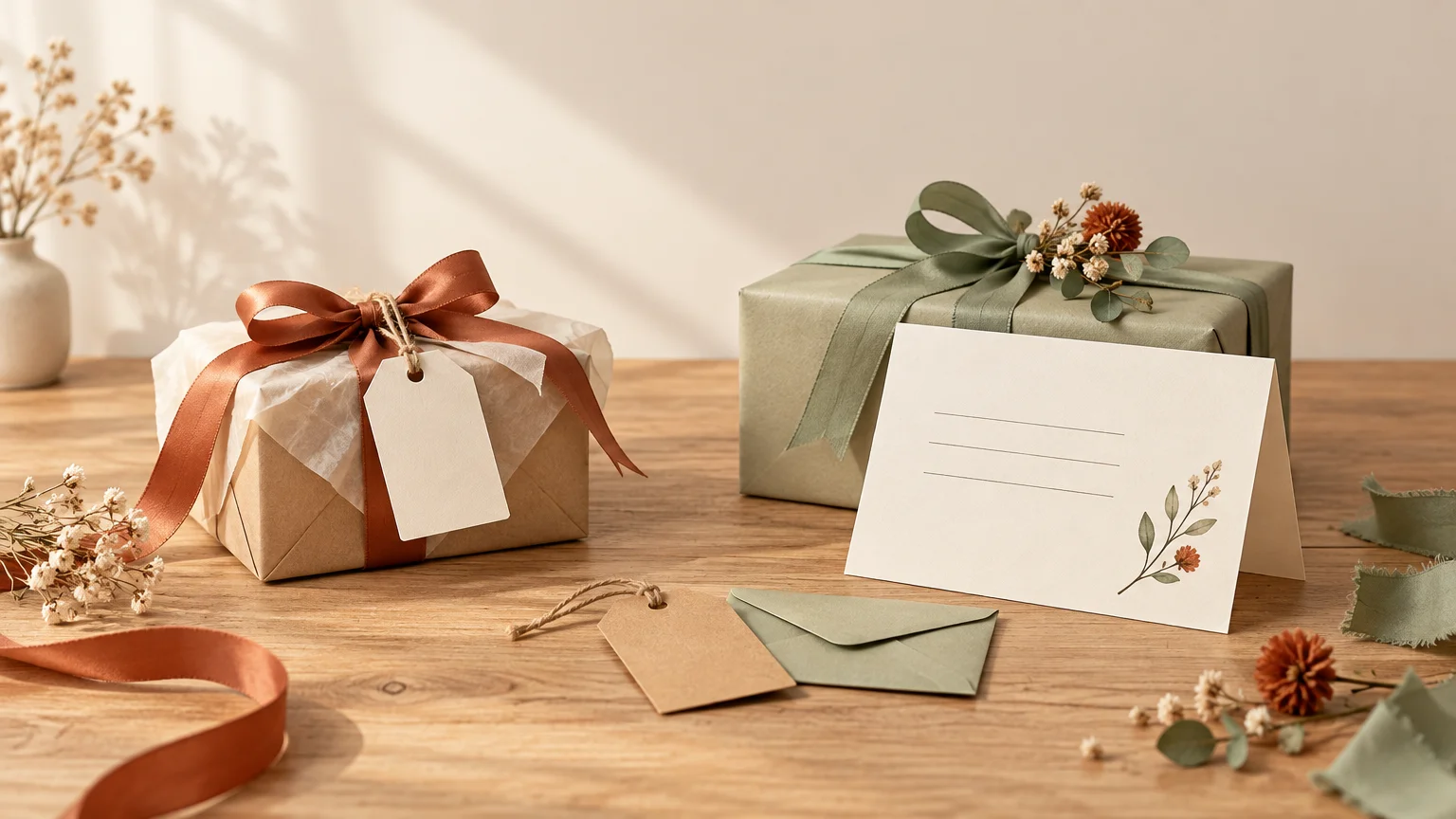
A tag introduces the gift. A card extends the feeling. That distinction works for almost every occasion, from classroom treats and coworker gifts to host presents, wedding-party gifts, and milestone celebrations.
Thank you cards vs gift tags at a glance
| Decision factor | Gift tag | Thank-you card |
|---|---|---|
| Best message length | A name, greeting, and one brief sentence | Several sentences or a short personal note |
| Primary purpose | Identify, decorate, or introduce the gift | Express specific gratitude |
| Placement | Tied, stuck, or clipped to the package | Inside the package, handed over separately, or mailed |
| Best occasions | Favors, treat bags, classroom gifts, holiday bundles, batch gifts | Host gifts, wedding gifts, mentors, major favors, milestones |
| Batch efficiency | Excellent for a repeatable message | Better when each recipient needs individual wording |
| Keepsake potential | Usually modest unless specially designed | Higher when handwritten or connected to an important event |
| Personalization | Names, date, icon, short phrase, or event motif | Names, shared memories, detailed thanks, and a personal closing |
| Mailing role | Usually accompanies a parcel or favor | Can be mailed independently in an envelope |
These are practical guidelines rather than etiquette laws. A heartfelt six-word tag can be enough for a casual gesture, while a small card can carry only two thoughtful sentences. Choose the format according to what the message needs to accomplish, not according to how formal the gift looks.
Choose a gift tag when the package carries most of the meaning
A gift tag works best when the present is already self-explanatory and your message can be understood at a glance. Think of a jar of cookies for a neighbor, small favors at a birthday dinner, coffee gift cards for a teaching team, or matching holiday bundles for coworkers.
Tags are especially useful when you need consistency across many gifts. One repeatable design can include the occasion, giver’s name, recipient’s name, or a short thank-you phrase without turning assembly into an evening of writing miniature essays.
Personalized gift-tag stickers and packaging labels can also combine the message with a practical job, such as closing tissue paper or identifying favor bags. CustomStickers presents gift-tag stickers and labels for personalized gifts and packaging, making this format relevant when you want a repeatable, package-facing detail. If you are preparing a large gathering, plan the tag’s use before choosing its shape or size; the same principle helps when you order stickers for an event.
A tag is probably enough when
- The message is one sentence or shorter.
- The gift is casual, repeated, or given to a group.
- The recipient already knows why you are thanking them.
- The tag mainly needs to identify the giver or recipient.
- The package would benefit from a decorative finishing detail.
- Writing a full card for every item would make the project impractical.
Do not shrink a paragraph until it technically fits. Tiny type, cramped handwriting, and sentences continuing around a punched hole are signs that your message wants to be a card.
Choose a thank-you card when the details matter
A card becomes the stronger choice as soon as your gratitude includes a specific detail. If you want to explain how you used a gift, acknowledge someone’s time, recall a shared moment, or name the difference their help made, give those words room.
Cards feel particularly natural after weddings, milestone birthdays, showers, graduations, major professional help, extended hospitality, or support during a difficult season. They also work well for mentors and close friends because the note can recognize the relationship rather than merely label the present.
A longer note does not need to be formal. Three specific sentences usually feel warmer than a page of general compliments. Start by naming what the person did, add the effect or memory that made it meaningful, and close with a forward-looking thought.
A card is probably better when
- You can name a particular gift, favor, memory, or act of support.
- The recipient may save the note.
- The thank-you is part of a wedding or milestone event.
- The note will be mailed rather than attached to another gift.
- The relationship deserves private words rather than a visible package message.
- You keep editing the tag message because there is more you want to say.
For deeply personal wording, the note itself can become part of the present. These ideas for turning a handwritten note into a keepsake gift can help when the message matters as much as the object beside it.
Use both for a polished outside and a personal inside
Using both is not excessive when each piece has a different job. Let the tag identify and style the package, then place the meaningful gratitude in a card. This is an especially good combination for a host gift, wedding-party gift, retirement present, or care package.
Imagine giving a weekend host a wrapped loaf, a jar of preserves, and a small kitchen towel. The exterior tag might say, “Thank you for making us feel at home.” Inside, the card could mention the late dinner they prepared, the room they made ready, and the conversation you enjoyed over breakfast. The tag completes the presentation; the card preserves the memory.
For a wedding-party gift, use the tag for the recipient’s name and a shared event motif. Put the individual story in the card: how they helped, what their friendship means, and what you hope to remember from the celebration. Matching colors or typography can connect the pieces without repeating the same message twice.
Repeatable templates that still feel personal
A template should provide structure, not erase the recipient. Keep the reusable opening and closing, then change one detail for each person.
Short gift-tag messages
- Thank you for making today brighter — from [name].
- A little something for a very big help.
- Made with thanks for [recipient].
- Thank you for celebrating with us — [date or event].
- For [name], with appreciation from [giver].
- You made a difference. Thank you!
A simple thank-you card structure
- Name the gift, favor, or moment: “Thank you for helping us set up the reception.”
- Add one specific effect: “Your calm organization gave us time to enjoy the morning with our family.”
- Include a personal detail: “I will always remember our last-minute ribbon repair.”
- Close warmly: “We are so grateful you were part of the day.”
For a casual card, compress the structure into two or three sentences: “Thank you for bringing dinner after our move. Eating your soup among the unpacked boxes made the new place feel like home. We cannot wait to have you over once we find the plates.” Specificity supplies the warmth; elaborate language is optional.
When professionally printed thank-you cards make sense
Professionally printed stationery is worth considering when you need a coordinated set for a wedding or milestone, want to upload finished artwork, or need a consistent design for a substantial mailing. Custom thank-you card printing can be a practical route for those projects. PrintInvitations states that customers can begin with a template or upload artwork and receive a digital proof before printing.
Proofing deserves unhurried attention. Its policy says customized printed orders are made to order and that wording errors appearing in an approved proof are not refundable. Check names, dates, punctuation, return addresses, and event wording on the proof rather than relying only on the original document.
Size should follow the message and mailing plan. As one useful reference point, PrintInvitations identifies an A2 folded card measuring 4.25 by 5.5 inches as a common thank-you format in its wedding-suite guidance, although that is not a universal requirement. For more help connecting cards with favors and event details, see this guide to personalized event gifts and coordinated stationery.
A quick mailing check before adding embellishments
A wax seal, thick bow, rigid insert, or square envelope can change how a card travels through the mail. USPS says letter envelopes must be rectangular and made of paper, and it notes that square, rigid, lumpy, clasped, string-tied, buttoned, or otherwise unusual pieces may require additional postage or different pricing. Its letter guidance lists maximum dimensions of 11.5 by 6.125 inches and a maximum thickness of 0.25 inch.
Before mailing an embellished or unusually shaped card, compare the finished piece—not just the empty envelope—with the current USPS letter-mailing guidance. If there is uncertainty, take a completed sample to a postal counter before assembling the whole batch.
Make the decision in three questions
- Can the complete message fit comfortably in one line? Choose a tag.
- Do you want to mention a person, memory, gift, or meaningful result? Choose a card.
- Does the package need a visible finishing detail and the relationship deserve fuller words? Use both.
For favors, classroom gifts, coworker treats, and holiday batches, begin with a repeatable tag and personalize names where practical. For hosts, mentors, wedding participants, milestone gifts, and meaningful acts of support, begin with a card. Add a coordinated tag when presentation matters.
Your next step is simple: write the message before choosing the paper product. If it naturally ends after one warm line, make it a tag. If a specific story or detail appears, give it a card. That small decision keeps the presentation tidy while ensuring your gratitude has exactly as much room as it deserves.
References
- Gift Tag Stickers | Custom Holiday Gift Tag Stickers – CustomStickers.com
- How to Personalize Any Gift with Custom Stickers – CustomStickers.com
- Custom Labels | Premium Quality | Lowest Prices – CustomStickers.com
- PrintInvitations | Custom Invitations, Announcements & Cards
- Refund and Returns Policy – PrintInvitations
- Wedding Invitation Suite Printing Guide: Invitation Sets, Save the Dates, Reception-Only Cards, and Thank You Cards – PrintInvitations
- How to Send a Letter or Postcard | USPS